A good car-free day in Cumbria is not about endurance. It is about choosing a village where the bus stop sits a minute from the shop, where a footpath leaves the middle of the village and arrives somewhere worth the climb, and where a later bus can carry you home while you are still finishing your tea.
Plenty of villages fail that test: one bus in, one bus out, both at awkward times. Here are the bases that pass, and what each one is best at.
A village earns its place on this list for practical reasons, not for prettiness.
Timetables across Cumbria change with the seasons, and the gaps show up in winter, on Sundays and in the early evening. Route numbers change too. Check the day before and again on the morning, and note the last bus rather than the second-to-last. If your whole day depends on one final service, have a fallback.
Grasmere sits on the 555 between Keswick and Windermere, and in season the open-top 599 runs down to Bowness. Both directions are useful, which matters more than it sounds: north to Keswick, south to Windermere, no car park involved.
From the village you have Dove Cottage and the Wordsworth Museum at Town End, the churchyard, and a gingerbread shop that has been doing one thing extremely well for a very long time. For walking, Easedale Tarn is roughly four miles there and back, steadily uphill without any scrambling, while Alcock Tarn is shorter and steeper.
The better car-free trick is to walk the old coffin route from Grasmere to Rydal — low, quiet and lovely — visit Rydal Mount or peer into Rydal Cave, then catch the bus back from Rydal rather than retracing your steps. Two miles of walking, and the bus does the rest.
If you want one base where a cancelled bus still leaves you options, it is Ambleside. The 555 and 599 both call, the 505 heads south to Coniston, and local services run into Great Langdale. Waterhead pier is a short walk from the centre, where the Windermere launches call.
Short walk: Stock Ghyll Force, ten minutes from the middle of town and at its best after rain. Longer: up to Loughrigg Terrace for the view down Grasmere, then drop into Grasmere itself and return by bus. One walk, two villages, no car.
It is not the quietest village in Cumbria and it is not trying to be. What it offers is choice.
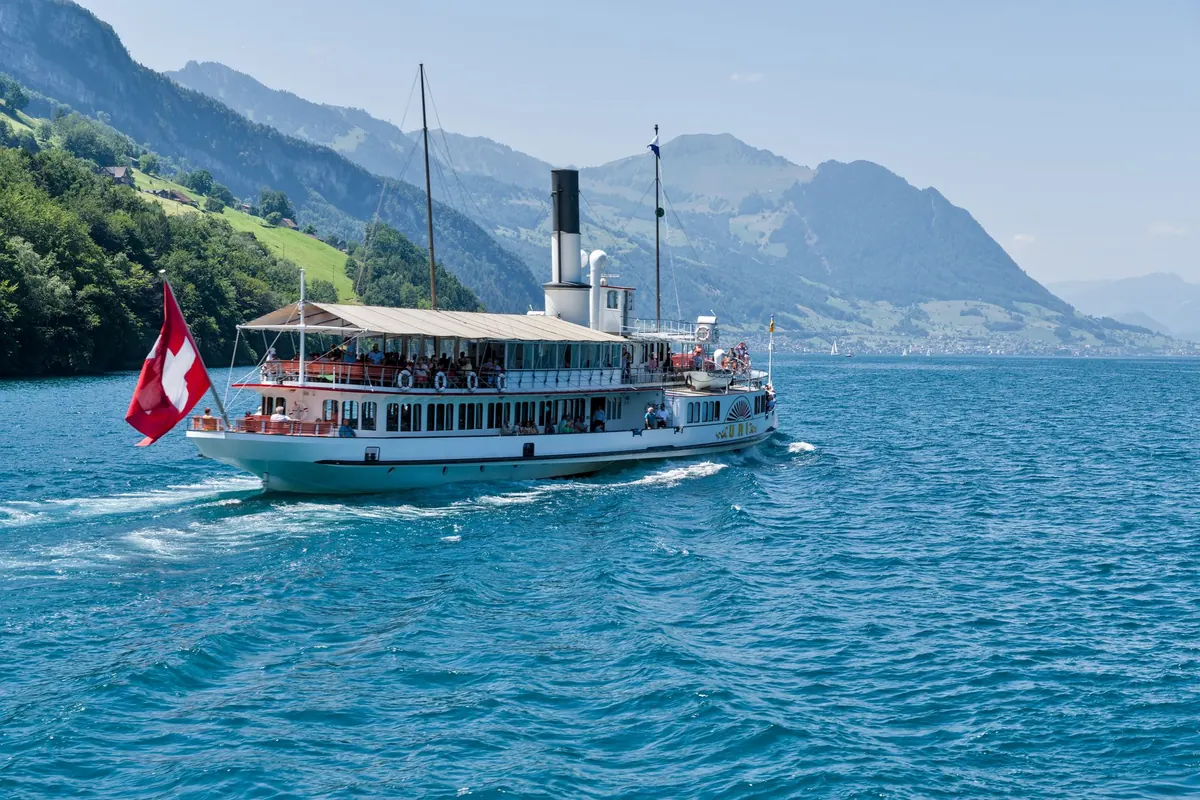
Coniston is served by the 505 from Ambleside and Kendal, and it works beautifully without a car. The Boating Centre is in the village, the steam yacht Gondola and the Coniston Launch both run on the water, and Brantwood, Ruskin's house on the east shore, is reachable by launch or by a shore path at an easy pace. The Old Man of Coniston is a proper mountain day that starts from the village street.
Hawkshead, a couple of miles on, is smaller and softer. Walk down to Esthwaite Water, or use the village as the middle of a genuinely car-free loop: train or bus to Bowness, walk to Ferry Nab, cross Windermere as a foot passenger, then follow the lanes to Hawkshead through Near Sawrey, passing Hill Top if it is open. Check the last crossing of the day before you set out — the return ferry matters more than the outward one.
Keswick's bus station is the best interchange in the north Lakes. The 555 runs south to Ambleside and Windermere. The X4 and X5 link Keswick with Penrith in one direction and Cockermouth and Workington in the other, which means you can arrive by train at Penrith and reach Keswick without a car at all.
In season the Borrowdale services — the 77 and 77A Honister Rambler and the 78 — head up the valley towards Seatoller and Honister Pass. Here is the trick anyone who walks here knows: get off at Hawes End and climb Catbells. It is a short, steep pull with the best return on effort in the Lakes. Then walk back to Keswick along the shore of Derwentwater, or pick up a later bus. The Keswick Launch also stops around the lake, so you can pair a one-way walk with a one-way boat.
The classic car-free day in the east of the county. The 508 runs from Penrith through Pooley Bridge to Glenridding, and Ullswater Steamers link the piers at Glenridding, Howtown and — on seasonal sailings — Pooley Bridge.
Two versions work well. Bus to Howtown, then walk the shore path to Glenridding: roughly seven miles, rolling but never savage, with the steamer waiting at the end. Or, if the weather turns, take the steamer one way and walk a shorter stretch between piers. Either way you finish at a pier with a bus stop nearby, which is the whole point. The transport handles the boring bits.
Not every car-free day needs a fell. The Cumbrian Coast Line calls at Ravenglass, where the narrow-gauge Ravenglass & Eskdale Railway runs up to Dalegarth in Eskdale. It is a small village with two stations, a beach, and Muncaster Castle about a mile's walk away. Check opening times and the tide before promising anyone a paddle.
Further up the coast, St Bees has a station and a cliff path to Fleswick Bay. Inland, the Settle–Carlisle line serves Appleby, where the station is a short walk from the broad main street, and Kirkby Stephen. One warning worth having: Dent station sits high on the moor about four miles from Dent village. A fine walk in good weather, a poor plan in bad.
A few things make the difference between a relaxed day and a stressful one.
Pick one village, one walk and one bus, and treat the timetable as part of the day rather than an obstacle. Do that and the car stops being the thing you plan around.
Photo: Petr Ganaj / Pexels